


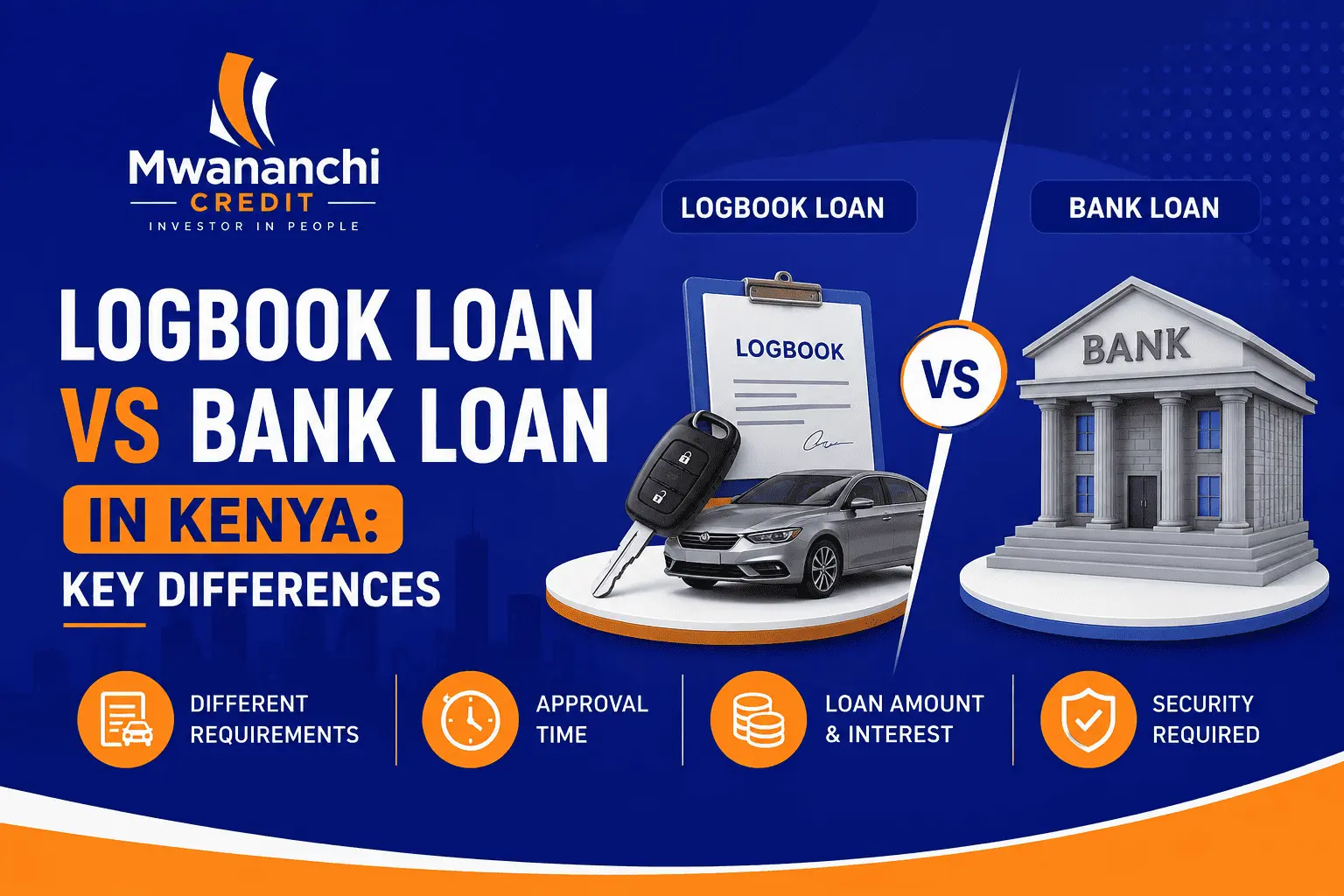
Logbook Loan vs Bank Loan in Kenya: Key Differences
It’s a matter of choice between a logbook loan and a bank loan. They all have different functions. Moreover, it’s important to understand how they differ to choose the right one.
Logbook Loan vs Bank Loan at a Glance
| Factor | Logbook Loan | Bank Loan |
| Security | Vehicle logbook | May be unsecured, or require other security |
| Main consideration | Vehicle value and ownership | Income, credit profile, bank criteria |
| Processing | Often designed for faster access | Can involve more assessment |
| Vehicle ownership | Performs as borrower, agrees with lender to retain ownership of the vehicle | Depends on the security transaction |
| Eligibility | Partly dependent on the vehicle and borrower criteria | Partly dependent on the bank’s lending criteria |
| Best suited for | Vehicle owners requiring secured financing | Bank requirements for borrowers |
This is a general guideline; it may not hold for every individual lender.
What Is a Logbook Loan?
A logbook loan is a loan that you secure using your vehicle. You own your car, and financing is related to the value of your car. Read all about logbook loans in Kenya.
What Is a Bank Loan?
Borrowers may borrow bank loans directly from a bank. These loans may be secured or unsecured depending on the type of loan. Usually, banks review credit history, employment and business records, and income before they approve an application.
Logbook Loan vs Bank Loan: Key Differences
Collateral requirements.
A logbook loan is a loan in which your vehicle secures the loan. Bank loans can be unsecure. But secured loans sometimes require property deposits or other assets.
Eligibility criteria.
Generally, logbook financing takes into account how you are able to pay back, the vehicle’s worth, ownership, age and condition. Typical bank loan considerations are income, employment history, credit history and existing obligations.
Processing time.
Compared to bank underwriting, it may require more documentation and credit checks to assess vehicle-based financing. Some lenders may require long or short time to process.
Interest rates and fees.
There are extra costs to both options. Such as processing fees, valuation charges, insurance and penalties, which may impact the total repayment. Always check the entire cost and not only the interest rate.
Loan amount.
The value of the vehicle and the lender’s loan-to-value (LTV) policy are typically the two factors that affect logbook financing. Income, affordability, credit status, and product type may affect the amount of any bank loan.
Repayment period.
There are different schedules of payment for both. Longer terms typically have lower monthly payments. But higher total interest paid, and shorter terms will have the reverse effect.
Credit score and history.
Credit history is often a crucial factor for banks. Vehicle security can also play a role in the overall assessment and the lender may take it into account. In either case, it’s about your capacity to pay.
Advantages of Logbook Loans Compared With Bank Loans
- For car owners, vehicle-based security may be an alternative to other types of security as collateral.
- Eligibility requirements may differ from those of banks. So borrowers who do not fit into a bank’s typical profile may be able to qualify.
- You lease your car for the term of the loan, as long as you agree.
- We now consider vehicle value for assessment in addition to income – not just credit history.
- May be appropriate for borrowers who have an existing vehicle, but no other assets to secure it.
Advantages of Bank Loans Compared To Logbook Loans
- More varied loan products, including different sizes, terms and uses
- Investors can purchase options without the risk of any particular asset
- Perhaps longer repayment plans which can reduce monthly repayments
- There may be parts of the application process that are easier if you have an existing banking relationship.
- Depending on the bank and your finances, some products might have more flexible terms.
Disadvantages and Risks to Consider
Logbook financing.
If you do not keep up with repayments, you risk losing your vehicle, and if you continue to miss repayments, the lender can repossess it. Other costs, including fees, interest, and valuation results, also impact the overall cost. So it’s a good idea to take them into account before signing.
Bank loans.
For some borrowers, stringent requirements, credit checks, and paperwork may make it more difficult to qualify. You may need collateral for secured bank products, and you may also incur fees.
When Is a Logbook Loan Better Than a Bank Loan?
A Logbook Loan May Suit You If…
- Own a qualified vehicle
- You’re the type of person who prefers vehicle-backed financing.
- The value of your vehicle is adequate.
- You can comfortably afford the repayments
A Bank Loan May Suit You If…
- You meet the bank’s income and credit requirements
- If available, you want an unsecured product.
- You don’t want to use your vehicle as security
- The bank’s terms are more appropriate for your financial situation.
Logbook Loan vs Bank Loan: Which One Should You Choose?
Compare your needs to the value of your car, your credit and income history. Moreover, you should compare your ability to repay and the total cost of borrowing. This includes fees and interest. Also think about what happens if you don’t pay on time. It will have different consequences for both options.
Questions to Ask Before Choosing a Loan
- How much will the total loan amount be for all of them?
- What fees apply?
- How much security is needed?
- If I fail to pay back, what will happen?
- How long is the repayment period?
- What kind of documentation do they need?
- May I pay it off early, and will there be penalties for doing so?
FAQ’s
What are the advantages of a logbook loan over a bank loan?
It varies depending on the circumstances. If you are looking for secured financing, a logbook loan might be a better option, and if you have strict bank requirements, a bank loan may be better.
Does a logbook loan have security?
Yes, your vehicle logbook is a form of security.
Is a bank loan secured or unsecure?
Both exist. Unsecured loans are not backed up by collateral, but secured loans usually are.
Which is quicker: a logbook loan vs a bank loan?
Lenders may process the loan differently, particularly for a vehicle, but the time varies.
Will a logbook loan have any impact on my credit rating?
It can, depending on the lender and your track record of repayments, be higher or lower.
So, which loan is better for the vehicle owner?
This is dependent on each person’s case; a comparison of both options against the needs of the individual is best.
Knowing these differences can aid your selection with confidence. If a logbook loan is suitable for you, read more about logbook loans in Kenya, who is eligible, terms and how to apply.