


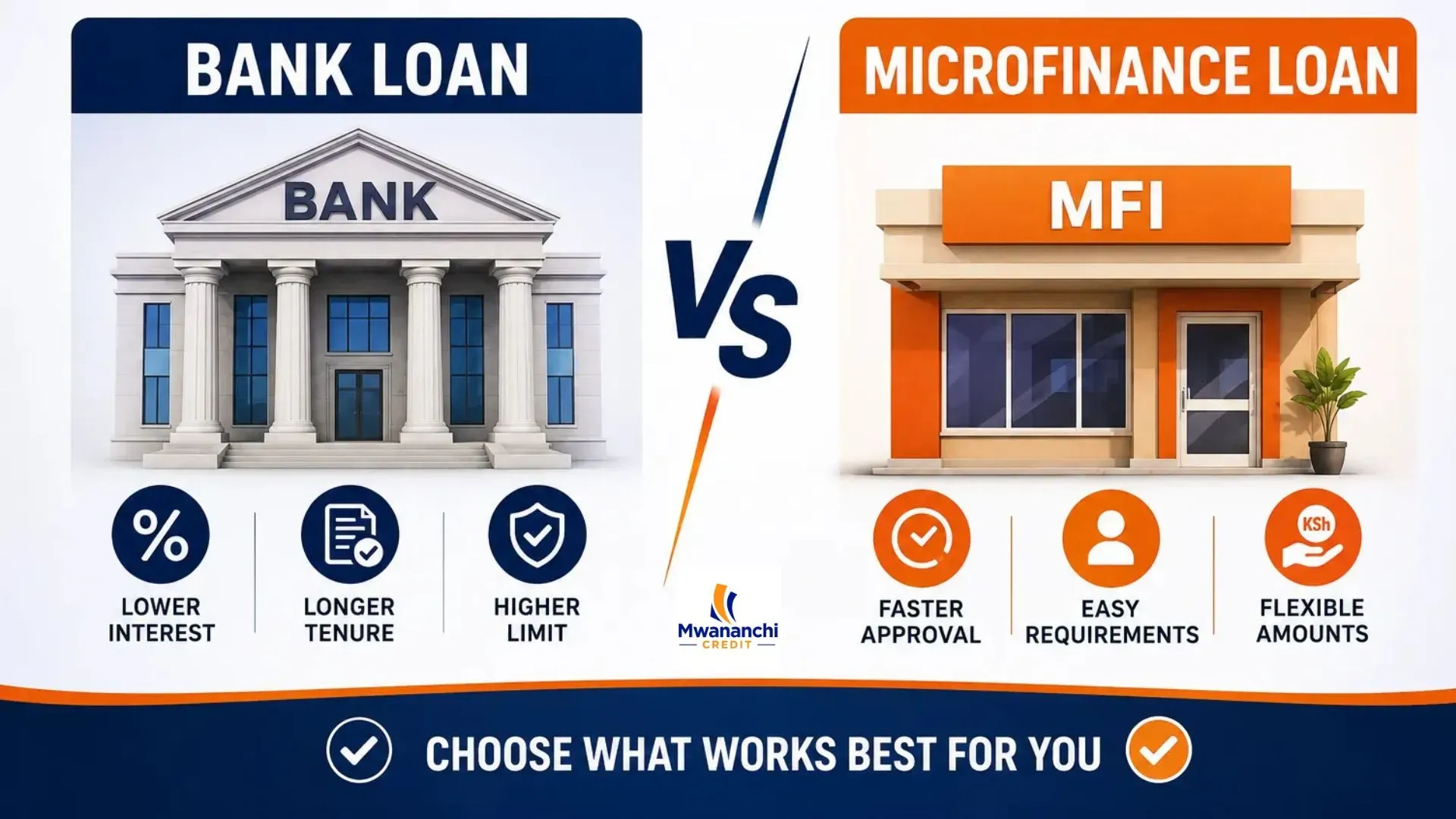
Bank Loan vs Microfinance Loan in Kenya
Making the correct decision about a loan can make or break your future. There are two most popular alternatives in Kenya: bank loans and microfinance loans. Learn about bank loans vs. microfinance loans in Kenya, and you will be able to choose the most appropriate option. This guide will assist those who want to make a decision about whether they should run their own businesses or if they need personal financing.
What Is a Bank Loan in Kenya?
A bank loan is one taken by a licensed commercial bank such as Equity Bank, KCB or Co-operative Bank. These loans are provided to salaried workers and in the business world with good credit records.
To qualify, you must meet the strict bank loan requirements Kenya lenders have set. These include:
- An authentic national ID or passport.
- Evidence of revenues or business accounts.
- CRB credit score is good.
- Pledge like a title deed or logbook.
Moreover, it takes more time, up to weeks, to approve. Lots of Kenyans in informal jobs find it difficult to meet the bank loan requirements Kenya banks set.
What Is a Microfinance Loan in Kenya?
A microfinance loan comes from a microfinance institution (MFI) like Mwananchi Credit, Faulu Kenya, or Kenya Women’s Microfinance Bank. These lenders cater to small business owners, low-income earners, and those who are unable to reach traditional banks.
The microfinance loan advantages Kenya borrowers enjoy include fast approval, flexible terms, and minimal paperwork. It takes 24-48 hours to apply and get the money. Also, MFIs may not necessarily demand collateral hence loans are available to more individuals.
Bank Loan vs Microfinance Loan Kenya: Key Differences
In the comparison of bank loan vs microfinance loan Kenya, there are several essential aspects to note.
1. Eligibility and Access
Banks demand official jobs and an excellent credit background. As a result, many Kenyans in the informal sector get rejected. In contrast, MFIs want to know whether you can repay. This lays out the difference between bank and microfinance in Kenya very plainly – MFIs are much more inclusive.
2. Bank vs Microfinance Interest Rates Kenya
Banks have an interest rate of 13%-18% per year, based on bank vs microfinance interest rates in Kenya. The annual interest rate of microfinance lenders is 18%–36%. Reduced bank rates are accompanied by entry difficulties. MFIs have higher costs, but provide services for the largest number of people in need.
3. Loan Amounts and Repayment Terms
Banks provide loans of great value – KSH 100,000 to millions with a term range of up to 10 years. Microfinance loans are between KSH 5,000 and KSH 500,000 with a short period of up to 3 to 24 months. A bank loan, therefore, is more appropriate in the case of big projects. Microfinance is quicker at working with funds.
4. Speed of Processing
Speed is one of the most important microfinance loan advantages Kenya borrowers enjoy. MFIs will give you credit in 24 hours. Weeks or days between banks. Microfinance is therefore more optimal in the case of urgent requirements.
Microfinance vs Bank Loans Kenya: Which Should You Choose?
- Select a bank loan when you have stable income, good credit and collateral and require huge sums of money.
- Get a microfinance loan when you are self-employed, require immediate cash, or have no security.
For ordinary Kenyans who are traders, farmers, or small business owners, the comparisons between microfinance vs bank loans Kenya tend to be biased towards the former. Most practical is the use of MFIs due to their ease of access and quick processing.
Why Consider Mwananchi Credit?
At Mwananchi Credit, we provide quick, cheap microfinance loans on repayment schemes that are flexible. We have something straightforward, clear and user-friendly. No hidden fees. No confusing paperwork. When you need it the most, simple financial assistance.
Final Thoughts
There is no one answer to the bank loan vs microfinance loan Kenya debate. It will depend on your income, urgency and credit history, which is your best alternative. For most Kenyans, however, microfinance loans are the best as they are fast, convenient, and flexible.
Ready to apply? Stop by Visit Mwananchi Credit and invest the first step towards achieving your financial objectives.
FAQs:
What is the main difference between bank and microfinance Kenya?
The key disparity between banks and microfinance in Kenya is access. Banks require collateral, formal income documentation and a good credit score. MFIs are easier to qualify for and take less time to be approved once set up, as smaller business owners and informal workers like them.
Are bank vs microfinance interest rates in Kenya very different?
Yes. At bank vs MICF interest rates in Kenya, the banks charge 13-18% per year, and MFIs charge 18-36%. Banks are less expensive and more difficult to get into.
What are the microfinance loan advantages Kenyan borrowers enjoy?
The greatest benefits of microfinance loans to Kenyan borrowers are rapid processing, forbearance of a few forms of paperwork, lack of collateral, and flexible payment terms – most of the microfinance loan requests are processed in 24-48 hours.
What do the lenders at the Bank of Kenya usually require when it comes to a bank loan?
Some of the typical bank loan requirements in Kenya are a valid ID, income documentation, a CRB check, and collateral. Registering documents can also be necessary for business applicants.
Which will be better: a bank loan vs a microfinance loan in Kenya?
Select a bank loan for high amounts and long-term. Select a microfinance loan to give it a quick and simple shot. Bank loan vs microfinance loan Kenya comparisons in the minds of most Kenyans would reveal that microfinance is a more viable option.